Archives for category: Bionics

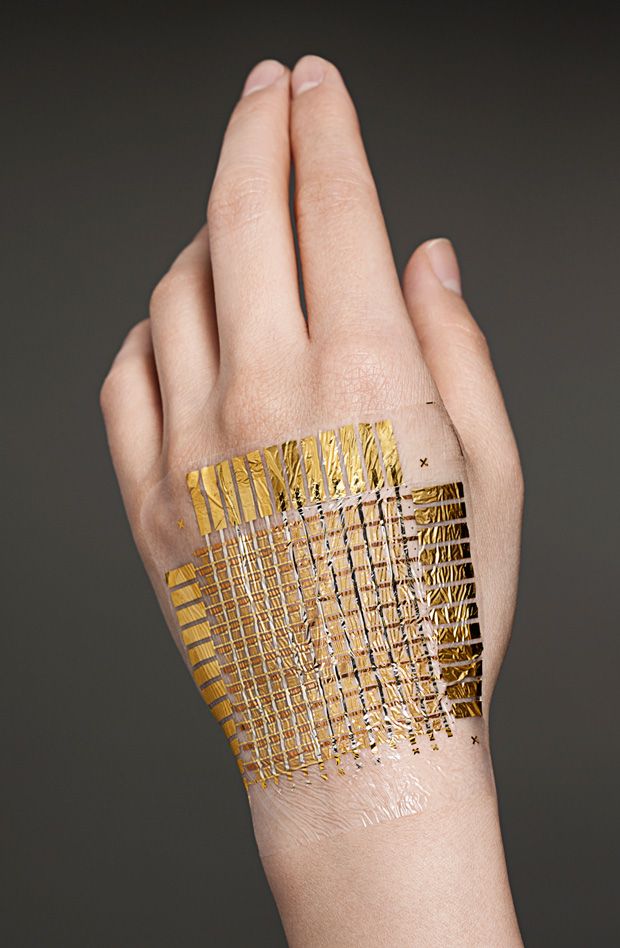
Someya's latest material

source

Skin is the largest organ in your body. covering more than two square meters. It is also one of the most important and most versatile; it is the first line of defense that we have in immunity, and contains an enormous amount of nerve endings and receptors that help us interact with the outside world; additionally it stretches and regenerates in order to accommodate our every movement. Whether we are responding to temperature, pressure, or a painful stimuli, it is our skin that sends signal to our brain to induce an appropriate response. Without it we are completely vulnerable. Having experience working in a burn unit and seeing the horrible effects of third and fourth degree burns that permanently damage our skin, these are awful injuries that leave someone with deformities, infections, and limited movement.

In the world of robotics, as devices become more lifelike and prosthetics advance for limb replacement, they will also require parallel form and function of human features.

All of this is why, it is so very exciting that at the University of Tokyo, Takao Someya’s lab has been developing an e-skin. This thin, flexible material has been years in the making, containing electronic sensors on a sheet of material that is one tenth as thick as a sheet of plastic wrap. The sensors include both temperature and pressure sensors which all used in the thin interface to conduct signals based on what they sense, just as we are able to do with our own skin. Additionally the material is also able to stretch and conform to varied movements without being damaged. This is all still in the development stage, and not for use outside of the lab just yet, but will be an amazing addition to the growing field of bionics once it is marketed and available for use in both the healthcare and technology fields.

Watch the video below for more information:

photo source

Diabetes is a chronic disease of the body’s inability to control blood sugar leading to, among other issues, amputations, vision loss, cardiovascular problems and nerve damage. Those with Type I diabetes often are born with the disease, and are diagnosed because of uncontrolled glucose levels and the inability of the pancreas to produce insulin, which is a hormone that helps to pull sugar out of the bloodstream and convert it to usable energy. The pancreas also produces the hormone glucagon, which works conversely of insulin and increases glucose levels in the body.

Those with type I diabetes must constantly monitor their body’s blood sugar and regulate it by sticking a needle into their body to deliver insulin. This old method is thankfully being upgraded according to a bionic pancreas whose effectiveness was confirmed in a study recently published in The New England Journal of Medicine, carried out by researchers at Boston University and Massachusetts General Hospital.

In two similar studies performed, adolescents and adults (over 21) were given a bihormonal (insulin and glucagon) pancreas to test which required only an iPhone and small subcutaneous device to deliver injections. Over 5 days, subjects were encouraged to eat and drink as normal while the device monitored their body’s response to meals. The device itself involved an iPhone which ran an algorithm which monitored glucose levels, and commanded the hardware interface to deliver specific levels of insulin or glucagon as needed through subcutaneous injection. Amazingly, this system updates every five minutes and adjusts hormone level as needed.

While this system is not for home sale yet, with such positive outcomes it will hopefully be on the consumer market soon.

The age of robotics has created a new kind of athlete, and the possibilities are quite amazing. 2016 will mark the first Cybathlon, to be held in Switzerland. This will be a competition for parathletes, called “pilots,” using robot-assisted technology. The competition is an Olympics-style event, featuring six different competitions, or “disciplines.” Each discipline features pilots with a specific category of injury using an appropriate device. In this competition, both the pilots and robotics companies are allowed the opportunity to win a prize. This competition is not only a victory for the advancement of robotics beyond basic function, but more importantly for athletes with life altering injuries such as amputations and spinal cord injuries.

The first competition will is an “Arms Prosthetic Race,” which features two events. Those with amputation of the arms using upper body bionic prosthetics to complete a two hand course using a loop around a wire, and a “SHAP course ADL” which is an upper body obstacle course requiring pilots to perform a series of tasks, grasping different kinds of objects in order to progress to the next.

The second discipline is a BCI (brain computer interface) race, in which participants mentally race avatars through a variety of obstacle courses. This discipline is for those with spinal cord injury at neck level, which has left them paralyzed from the neck down.

The discipline close to heart, however, is the “Powered Exoskeleton Race.” Did we ever think we would see a day when athletes with spinal cord injuries leaving their lower body without motor control would run in an Olympic-style event? This discipline will feature an obstacle course including stairs, ramps, slopes, narrow beam and others, ending in a final sprint. Wow.

For those with spinal cord injuries leaving their trunk and upper body motor control intact, Discipline three features an FES (Functional Electrical Stimulation) bike race. An FES bike assists lower body movement while the trunk and arms work to help control the bike around a race course.

A Leg Prosthetics Race and Powered Wheelchair Race comprise two other disciplines for those with lower body injuries.


The beauty of robotics is not only the creativity involved, but the ability it has to allow people recovering from life-changing accidents to transition back to normal life.

An article in the New Scientist describes the story of Jason Barnes, a young drummer who lost his arm below the elbow while working at a restaurant. Through meeting Gil Weinberg, the founding director of the Georgia Tech Center for Music Technology, and working with a drum instructor, a robotic arm was developed that would help Jason return to drumming. The arm was just completed recently, and will make a debut in concert at the Atlanta Science Festival on March 22nd.

According to the Georgia Tech Center for Music Technology site, the prosthesis features two drumsticks that can play at different rhythms. One drumstick responds to cues from Jason’s upper body, as he contracts the stick responds to cues from upper arm muscle contractions and electromyography signals. The second stick has a “musical brain” and improvises to play with the other to create rhythm.The synchronization technology allows the second stick to play with the first as it receives cues from muscles that the first stick is about to hit the drumset. An embedded chip controls the speed of the drumsticks, which is what allows the sticks to play at two different rhythms.

Jason Barnes will debut this prosthesis on March 22nd. Read the New York Times press release and see the video below:

There are many situations, such as those in emergency environmental conditions, where we are limited in crossing land due to safety limitations. Additionally normal vehicles have difficulty navigating uneven terrain. Google recently acquired Boston Dynamics, which describes itself as ‘an engineering company that specializes in building dynamic robots and software for human simulation.’ This company lists 9 robots on its website, each with a different shape, function, speed to perform a variety of tasks. The machines are impressive in size and ability to simulate locomotion on uneven terrain and different inclines. One of these robots is “BigDog,”a crude-looking beast which weighs in at 240 lbs and is about 2.5 feet tall, designed to mimic the size of a large dog or mule. This robotic animal ‘runs at 4 mph, climbs slopes up to 35 degrees, walks across rubble, climbs muddy hiking trails, walks in snow and water, and carries 340 lb load.’ Unlike a car which is limited in uneven terrain, this machine can stand, walk, trot, run, crawl, and gallop. Components include heat exchanger, engine, computer, actuators, leg spring, and force sensor. Simulated animal joints include hip, knee, ankle and foot. Though this machine is still being improved for noise, righting, autonomy and navigating even rougher terrain, it can provide many uses in which we are currently limited.

ReWalker Oliver, Berlin, Germany

source

The purpose of this blog is to connect robotics to industry. However, as a physical therapist, I have to say I am personally vested in the amazing products that have been developed for rehabilitation in the past few years. The ReWalk is another great product that allows for the mobility of those who are otherwise wheelchair bound. A bionic exoskeleton with forearm crutches allows those with lower body impairments to stand, walk, and see others ‘face to face,’ as their website points out. Additionally, ReWalk also allows for clients to participate in exercise that is otherwise unfeasible due to their physical limitations. Their models are available at a number of rehabilitation centers throughout the US, Europe, and Israel.

Update: The ReWalk has now been cleared by the FDA for personal use outside of rehabilitation centers.

source: http://behance.vo.llnwd.net/profiles5/199443/projects/594952/f5a489316d270b0480a83a7406509115.jpg

The factors involved in developmental disorders such as autism are complicated and numerous. Some of the known and common characteristics that children have are decreased eye contact, delayed social and communicative skills and possible altered sensory response.

People, including children, can be unpredictable and impatient. This patience can be especially limited for those with delays in speech, communication, and interaction. Social interaction, like everything else, takes practice, and this is a great, simple device which allows the facilitation of those social skills which a child may be lacking.

The Keepon Pro is a simply designed robot that hides its more complex function. It is an interactive robot which can maintain eye contact, convey attention by turning and nodding, and express emotion by rocking side to side and bouncing up and down. This allows children with developmental disorders to, among other things, practice social interaction in a safe and predictable environment. Having handled one of these, I can say that it is a small simple device that reacts to the amount of pressure that you press it with, so there is definitely a feedback component.

At least one study  has shown that Keepon encourages children to be socially interactive and share their emotion and attention with others.

Full-size image (32 K)

Kozima H, Nakagawa C, Yasuda Y. Child-robot interaction: a pilot study in autism therapy. Progress in Brain Research. 2007; pp385-400.

I was told they were on sale for about $30-40 but sold out, so I am not sure of where they are for sale now and was not able to find the information on their site. You are able to download a 2D version on your iOS device.

https://i0.wp.com/www.inquisitr.com/wp-content/2011/12/ekso.jpgsource: inquisitor.com (http://www.inquisitr.com/wp-content/2011/12/ekso.jpg)

We spend the first year of our lives preparing to take our first step, and so begins our life as creatures who rely on our two legs to ambulate. There probably appears nothing as devastating as losing this function, only to be confined to a wheelchair. This often happens to otherwise young and healthy individuals as the result of a spinal cord injury, injuring the nerves that send signals to the muscles they control. The higher up the injury is toward the head, the more muscles are affected. Those with injuries to the spinal cord in the lower back will lose function of their leg muscles; their arm muscles are not affected and thus allow them to propel a wheelchair or crutches.

We are made to walk, and not sit; thus long term use of a wheelchair not only affects muscle tone but also digestion and other vital bodily functions. The sooner someone can stand up and begin walking again after injury, the less long term effects there are on the body.

Robotics exist to fill the need for those functions that we can either not fulfill or are unable to perform efficiently, and walking is no exception. There are several companies in recent years which have released products which allow wheelchair-bound people with paralysis to stand and walk. One of these companies is Ekso Bionics, which has produced an amazing bionic exoskeleton that does just that; their tagline on their website states “Ekso is the bionic exoskeleton that allows wheelchair users to stand and walk.” Their product consists of a lithium battery powered exoskeleton which powers motors at the hip and knee, along with crutches or a walker. There are several modes which meet client needs, one of which amazingly adjusts power to one side when only one side is affected by injury such as stroke.

Currently the product is available only for use in rehabilitation centers under the supervision of a physical therapist, but the website states a personal version for home use may be launched as early as next year.

Read more at http://www.eskobionics.com