Archives for category: robotics

For those with diminished strength or function of the hand, daily tasks that we often take for granted may become difficult, essentially disabling someone in their daily life. To address this and increase efficiency of the performance of the hand, researchers at MIT have developed “Supernumerary Robotic Fingers,” a type of wearable robotic device with two extra fingers to complement the grasping function of a regular hand.

In normal human movements we have muscles that work synergistically, meaning that there is a central signal from the brain that allows them to contract together to create a certain movement. For example, when the biceps contracts to bend the elbow, the muscle brachialis contracts as well to help facilitate this movement. This allows for efficiency of tasks in our body.

An article titled Bio-Artificial Synergies for Grasp Postural Control of Supernumerary Robotic Fingers explains how the researchers have developed an algorithm to allow the robotic fingers to work synergistically with human hands. That is, the extra fingers are designed to correlate with the human movements to work as an extension of the human hand and enhance activity to form essentially a seven-fingered hand. The researchers use the concept of “Bio-Artificial Synergy.” Thus, the researchers have essentially developed extra fingers that replicate the movements of muscles in the human hand.

The device is mounted on the wrist, and through a sensor glove receives a signal from the hand and works alongside the five fingers to assist with grasping objects. The robotic fingers are longer than human digits, making it easier to grasp larger objects. Each robotic finger can move in 3 different directions. For those that have difficulty holding onto objects or performing coordinated movements, this can be an invaluable tool to perform tasks independently.

Because of these extra fingers, the user is able to perform tasks that are normally difficult to perform single-handedly, such as twisting open a bottle cap, holding a tablet and typing, This product is still in the development phase, and though researchers have amazingly been able to correlate the robotic hand angles with human hand angles for grasp, they have not yet completed algorithms for fingertip forces.

The article mentions that this devices has implications not only for elder care, but for construction and manufacturing.

See the video below for more description of this amazing device:

photo source


loop_optimized_bluebg2.gif

source

There have been awful events happening in the world lately, and sometimes you just need the distraction of a giant robot that juggles cars. Still in the investment and development process, the BugJuggler is a 70 foot tall robot that can juggle cars using a diesel engine that will generate energy via hydraulic pressure. To invest or learn more go to the website or see video below.

source

As our rate of multitasking increases, we may as well embrace the age of interactive robots in our home. Crowd-funded JIBO by Cynthia Breazeal is a personal robot with a variety of functions. According to the website, JIBO can see, hear, learn, help, speak and relate. It is a personalized robot that can take orders, tell interactive stories, make video calls, and sense social and emotional cues to respond appropriately to its user. As you walk around a room, it has enabled face recognition and responds to you appropriately. While we have seen components of these in other devices, JIBO is more of a polished home companion that can interact both with other devices and humans.

Available at the end of 2015, can be pre-ordered for $499.

See the promotional video below:

photo source

The future of healthcare includes robotics devices which mimic living tissue and may help to target and perform functions with superior accuracy and efficiency of drugs. A 2014 study by Cvetkovic et al. presented the first engineered skeletal muscle machine which moved unattached to any other device. These small soft robotic devices were able to contract and crawl on their own, mimicking the function of skeletal muscle tissue. The shell of the machine is made from hydrogel to encase the tissue. Meanwhile, engineered muscle building cell tissue, along with proteins such as collagen or fibrin were printed on 3D printer and encased in this shell to make the tissue functional.

The many systems that need to be coordinated for muscle contraction are difficult enough to just understand, but to be able to engineer something that mimics the function is amazing. For muscle tissue to contract and produce force requires an intense network of neural input and coordination of responsive tissue. There must be enough elasticity in the muscle to produce the force; ultimately the change in length and contraction of muscle tissue produces the force for movement. The tissue must be slightly stretched at all times for potential contraction; but not so far that it loses the ability to contract. This all occurs with electrical cues which send signals to the muscle tissue for contraction.

The future of these small biological machines has many implications, as the article explains. Future uses include drug screening, drug delivery, medical implants, and biomimetic machines.

See the video below for demonstration:

Someya's latest material

source

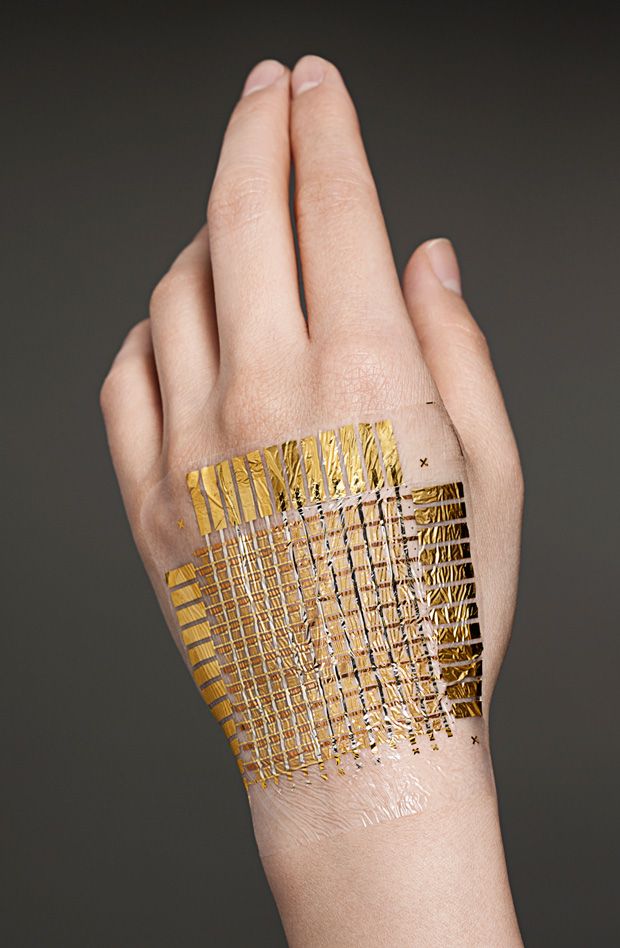
Skin is the largest organ in your body. covering more than two square meters. It is also one of the most important and most versatile; it is the first line of defense that we have in immunity, and contains an enormous amount of nerve endings and receptors that help us interact with the outside world; additionally it stretches and regenerates in order to accommodate our every movement. Whether we are responding to temperature, pressure, or a painful stimuli, it is our skin that sends signal to our brain to induce an appropriate response. Without it we are completely vulnerable. Having experience working in a burn unit and seeing the horrible effects of third and fourth degree burns that permanently damage our skin, these are awful injuries that leave someone with deformities, infections, and limited movement.

In the world of robotics, as devices become more lifelike and prosthetics advance for limb replacement, they will also require parallel form and function of human features.

All of this is why, it is so very exciting that at the University of Tokyo, Takao Someya’s lab has been developing an e-skin. This thin, flexible material has been years in the making, containing electronic sensors on a sheet of material that is one tenth as thick as a sheet of plastic wrap. The sensors include both temperature and pressure sensors which all used in the thin interface to conduct signals based on what they sense, just as we are able to do with our own skin. Additionally the material is also able to stretch and conform to varied movements without being damaged. This is all still in the development stage, and not for use outside of the lab just yet, but will be an amazing addition to the growing field of bionics once it is marketed and available for use in both the healthcare and technology fields.

Watch the video below for more information:

Being permanently confined to a wheelchair not only limits you for health reasons, but wheelchairs are also a huge physical barrier to traveling between locations. Even if a target destination is coined ADA accessible, logistically getting to and from a location can have so many barriers that it may not be worth the trip. Constantly relying on others for assistance, not being able to speak at eye level, the physical impact of constantly sitting are some of the problems those that are confined to a wheelchair must experience.

Developed a couple of years ago but finally being released for sale on the market sometime this year, Tek Robotics has developed a robotic mobilization device that allows an individual to independently stand, and then mobilize them to a location that may not be wheelchair accessible. Each device supports a person from behind and gently pulls them into standing position, all without the assistance of a second individual. Instead of throwing the body forward as needed to heave someone out of a wheelchair, this battery-operated devices uses a gas spring to help suspend a person in a standing position. The dimensions are thin enough to fit through a regular doorway (it occupies one third the width of a wheelchair, states the website) but also designed for balance even with the narrower base.

Reservations are now being taken for shipment sometime this year. Each unit will cost approximately $15,000. See the video below for more explanation:


photo source


Most emergency medical training involves lifeless torsos, videos, and noninvasive simulated work on a live partner in which you haphazardly  practice what you would actually have to do in an emergency situation. From my personal experience of many CPR classes as well as a course of emergency medical training, I can attest none of this prepares you very well for what you would actually have to act out in a life threatening situation. No, you can never fully prepare for having to rescue someone, but what gives you the confidence to do it is practicing something similar prior to having to act on the spot.

Kernerworks has developed a realistic robotic mannequin that breathes, bleeds, and responds to procedures to give feedback if they have been performed correctly.This company in San Rafael, CA includes a team of former special effects artists that used to work for film studios. The mannequins were molded from real people, given realistic features, and have an internal computer system that includes sensors which respond to procedures.

Used for military training for trauma response, one of the products is a double amputee mannequin which allows trainees to practice relieving pnueumothorax with a needle (sensors respond if done correctly). One of the features is also a well developed throat which features air differential sensors. Medics can practice placing a laryngoscope into the throat which has a camera so you can see the placement of a tube for breathing. An endotracheal tube can be placed in the throat for use of an Ambu bag, if done correctly this shows the chest rising. If it is done incorrectly and the tube is accidentally placed into the esophagus, the chest will not rise. Unlike most practice torsos, these are sensors responding to these procedures, which are much more precise. Watch the video above for a tour Tested shared which explains more about the company and the incredible work behind the mannequins.

https://encrypted-tbn2.gstatic.com/images?q=tbn:ANd9GcRssvil4tC15z-pOM2KJzrZKqY8RxdroRFE6uo1fJzq63z1EsKT

source

Surgery has come a long way with many facilities now using robotics to either assist or replace human tasks. Delicate procedures that require a lot of precision, repetition, and endurance can benefit from the use of such technology. A few years ago, CardioARM was developed for minimally invasive heart surgery. This device resembles a snake, which can travel to the target areas through insertion beneath the sternum and perform ablations of heart tissue that is disturbing heart rhythm. Ablation, meaning the target area of heart is burned away. This procedure replaces the more invasive task of opening the chest cavity and cutting away into your vitals. For anyone who has ever visualized the inside of a body, it is amazing that a device is not only able to navigate but reach a specific area of the heart and perform an ablation on target tissue.

CardioARM features 50 links which are connected by cables and can move in a combination of 105 different movements. The device can move forward and reverse, and is headed with a camera and light guide to allow for visualization. Once the CardioARM enters under the xyphoid process (bottom of the sternum), it is directed toward the specific region of troublesome heart tissue. Once it reaches its target, it delivers a “dot to dot” procedure for the ablation. Each lesion is delivered 30 watts of power for 30 seconds.

In 2011, this device was first successfully tested in human clinical trials. As it takes a long time for such devices to actually enter hospitals, this will hopefully become an option soon for surgeons dealing with life threatening arrhythmias.

The beauty of robotics is not only the creativity involved, but the ability it has to allow people recovering from life-changing accidents to transition back to normal life.

An article in the New Scientist describes the story of Jason Barnes, a young drummer who lost his arm below the elbow while working at a restaurant. Through meeting Gil Weinberg, the founding director of the Georgia Tech Center for Music Technology, and working with a drum instructor, a robotic arm was developed that would help Jason return to drumming. The arm was just completed recently, and will make a debut in concert at the Atlanta Science Festival on March 22nd.

According to the Georgia Tech Center for Music Technology site, the prosthesis features two drumsticks that can play at different rhythms. One drumstick responds to cues from Jason’s upper body, as he contracts the stick responds to cues from upper arm muscle contractions and electromyography signals. The second stick has a “musical brain” and improvises to play with the other to create rhythm.The synchronization technology allows the second stick to play with the first as it receives cues from muscles that the first stick is about to hit the drumset. An embedded chip controls the speed of the drumsticks, which is what allows the sticks to play at two different rhythms.

Jason Barnes will debut this prosthesis on March 22nd. Read the New York Times press release and see the video below:

It was only a matter of time before our machines became not only a functional, but emotional part of our lives. As devices become more and more personalized, we are drawn toward them in a way that we are drawn toward the people in our lives. “It knows me,” this personalization seems to say. And as these devices become more personalized with recognition features, where do we draw the line between functional robotics and love? After all, don’t robotics exist to fill a gap in life or make it more efficient? And aren’t humans sometimes unpredictable and unreliable, unlike our machines?

The Artificial Intelligence and Robotics Technology Laboratory (AIART) in Tawain has been developing a lovotics robot to further explore the human to robot relationship. Involved in this development is the understand of the physiology behind love, which of course is a complex combination of factors including hormones, affect and emotion. According to their website, the artificial intelligence in the lovotics lab mimics the different human systems involved in love and includes the development of an Artificial Endocrine System (physiology), Probabilistic Love Assembly (psychology), and the Affective State Transition (emotions).

The lab has worked on mimicking a myriad of human hormones, evaluating gestures and expressions. The psychological unit has looked into numerous parameters such as proximity, similarity, attachment, attraction, and reciprocal liking, among others. The robot not only enables these human components, but adjusts them based on input and feedback. Amazing, is love as mysterious as we like to think or a controllable environment of many components? This opens the window to questions of our future, will relationships as we know them change? See the video below.

And a video with more explanation: