Archives for category: robotics

For those that prefer independent living but require assistance with dally tasks such as eating, Swedish company Bestic has developed a robotic arm that assists with eating. It can be programmed for height, speed, and type of food, and allows the user to eat alongside others without requiring the assistance of another person. For those with musculoskeletal and neurological injuries and diseases that render their upper body muscles weak or with tremor such as Polio, MS, Parkinson’s or Ataxia, this allows for some normalcy at mealtime.

Those that are interested in trying the device can contact the makers through their website.

Watch the video below:

It always seemed so far away that we would be able to control our environment with just our brains, but as our brains produce electrical signals, it was only a matter of time that these could be converted for use in technology. Muse by Interaxon is a brain-sensing headband which uses EEG’s to detect changes in brainwaves which are meant to convert to digital signals. This product features 6 sensors in the headband, and using a tablet or PC the changes in brainwaves can be monitored for mental acuity and relaxation exercises. In a time when our brains can easily fatigue from the constant multitasking and refreshing of our technology at hand, this is something that can prove very valuable to allow us to improve our concentration and get feedback should we lose our focus.

Future implications given on the website include controlling music, playing games, and changing home environments.

Home units can be pre-ordered now for $299. These headbands come in black or white, and include a Calm app and free basic software development kit.

Watch the video about the product below:

Our body has an amazing sense of recognizing something as self or foreign, harmful or beneficial. However, our interpretation of this data and pinpointing specific diseases leads to the sometimes complicated world of diagnostics. The process of finding what disease, organism, or bacteria is present in the body, then recognizing and analyzing it involves multiple systems. Funded by the the U.S. National Science Foundation (NSF) and the U.K. Engineering and Physical Sciences Research Council, scientists are developing a small ‘biohybrid’ robot called the Cyberplasm which uses living cells and technology to find and interact with bacteria and cells within our own bodies. Once something is identified, it can be reported back to an engineered nervous system to interpret. Based on the form and function of a sea lamprey, a simple sea creature pictured above, the small robot will be able to swim through our bodies to possibly record data, find and identify diseases.

This is no small feat. In order to achieve this, the Cyberplasm is equipped with synthetic muscle to propel it through the body, which requires the biologic conversion of sugar to energy. Synthetic sensors scope the environment and report back to an electronic nervous system. This is all part of an engineering principle called “Synthetic Biology,” where man made devices mimic life’s functions. Optoelectric interfaces are being developed to adapt and respond to a changing environment as the robot swims through the body. The power of the robot will come from microbial fuel cells, a renewable energy, converting bacteria to electric current and energy.

Knightscope is Silicon Valley based company that has been developing a personal security robot for use in the streets, schools, and other public areas. The five foot surveillance camera includes facial recognition, a laser imaging sensor that can map a 3D area, and thermal imaging among other capabilities. After public tragedies occur, we often wish there was something to predict and recognize that something was amiss. Some of the many limitations of human security is our field of vision, inability to see through crowds, and sleep cycles. A machine that can crowd source for security and raise flags that the human eye cannot detect may help small and large scale tragedies from occurring.

A mock control center displays some of the capabilities that this 500 lb robot has:

These machines are not for sale yet, and will be tested at the 2014 World Cup in Brazil.

ReWalker Oliver, Berlin, Germany

source

The purpose of this blog is to connect robotics to industry. However, as a physical therapist, I have to say I am personally vested in the amazing products that have been developed for rehabilitation in the past few years. The ReWalk is another great product that allows for the mobility of those who are otherwise wheelchair bound. A bionic exoskeleton with forearm crutches allows those with lower body impairments to stand, walk, and see others ‘face to face,’ as their website points out. Additionally, ReWalk also allows for clients to participate in exercise that is otherwise unfeasible due to their physical limitations. Their models are available at a number of rehabilitation centers throughout the US, Europe, and Israel.

Update: The ReWalk has now been cleared by the FDA for personal use outside of rehabilitation centers.

As an adult, you are expected to enter situations with a certain composure. Hyperventilating or crying while getting your blood drawn is frowned upon, though many of us naturally have this reaction as someone is prodding our blood vessels, looking to extract the blood our body works so hard to make.

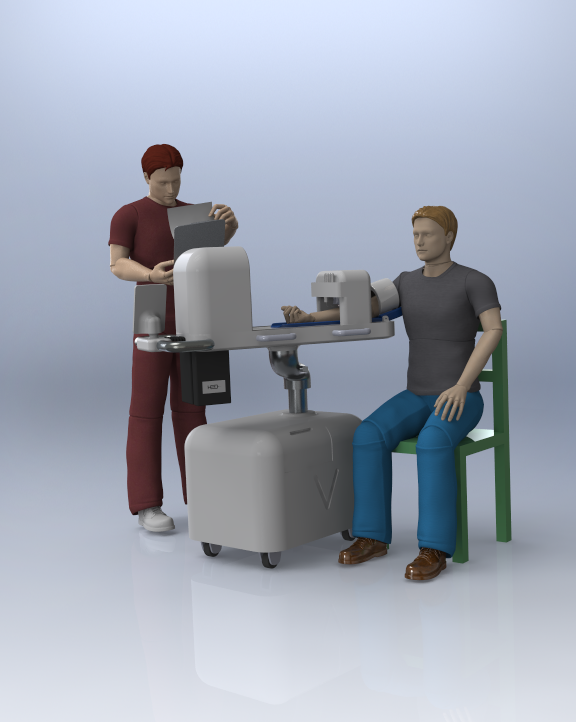
Veebot looks to make this a more efficient, accurate process for predictability and efficiency, which may possible quell the young and not so young when going in for a common blood drawing procedure. According to their website , 20-25% of phlebotomy procedures fail to draw blood on the first stick. That’s 20-25 out of every 100 procedures. Not very efficient.

Veebot’s team has developed a robotic devices with a viewing system that identifies and selects the best insertion site. Using lighting and ultrasound viewing techniques, once selected the machine can insert the needle. According to sources, the process takes about a minute.  A technician must still be present to oversee the procedure, so to assuage some fears  it will not just be you and a needle-sticking robot alone in a room together.

RP-7i Remote Presence Robot

As a physical therapist, being required to be physically present for your career can be both a burden and a relief. I can breathe a little easier (for now) knowing that my job probably won’t be outsourced any time soon, as it requires physical touch and presence. I also look forward to the day, however, when I am feeling under the weather, or when life’s circumstances keep me from going into work that I can still, at least partially, do my job from home.

Interestingly enough, there are now telepresence robots which allow doctors to advise patients by telecommuting. While this may be in the further future for PT’s,  There are 5 different models listed on the InTouch Health website.

These products are described as remote presence devices, they allow clinicians to interact with patients in real time. In life threatening situations, these can be vital in saving time so that a physician in a hospital can consult patients or support staff to guide treatment without wasting wait time. In less immediate situations, they can just add convenience to healthcare without patients losing work time with travel. Many people simply let medical conditions fester to the point of immediate concern because of the time and effort it takes to get to a medical appointment, and we could potentially save so much in healthcare costs by allowing people the gift of time and convenience to address medical concerns before they require increased tests and procedures.

I hope that as a PT I can soon provide consults to patients requiring less manual treatment and more instruction and guidance without the inconvenience and costs required to physically attend a medical appointment.

photo above: http://www.intouchhealth.com/images/rp-7i-big.png

Paro Robot Seal Healing Pet

The benefits of having a pet are well known, and animal-assisted therapy is widely used in hospitals and rehabilitation centers to comfort and engage patients. Of course, you don’t have to have a medical condition to benefit from animal companionship. I remember witnessing two black labs tear through a spinal cord rehabilitation unit, they ran all over all the mats, jumped on everything, and in a controlled medical environment it was refreshing and put a smile on everyone’s face.

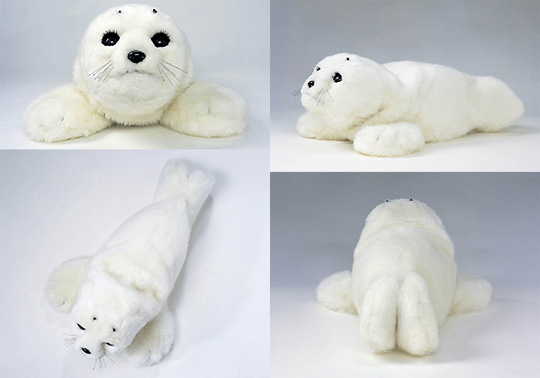
For those with dementia, or alzheimer’s, taking care of a pet is normally not an option. Elderly people with altered mental states can be forgetful, neglectful, and are unable to safely and consistently care for other living beings. Developed about 10 years ago, the Paro Robot is a brilliant product, it is a robot harp seal with the characteristics of a pet such as sound and name recognition, tactile sensors, and emotional displays. It has hypoallergenic “fur, ” encourages communication and relaxation. More information is available on the website, but use of the Paro is backed by patient questionnaires indicating a decrease in depression and improvement in mood with use of Paro. While “robot therapy” may seem like an oxymoron term, a product such as this that may improve the quality of life of those with dementia and alzheimer’s whose days may otherwise be filled with fear, confusion and loneliness. In less extreme cases, they can do what any pet will do; make your day just a little better.

Additionally, this is a study published in 2011 in Gerontology examining the benefits of robot therapy (including the paro robot):It goes into detail into the function and use of the Paro, which is pretty amazing.

https://i0.wp.com/www.barobo.com/wp-content/uploads/2011/01/P1040403.jpg

In order to achieve and recreate anything in a higher function, you must always first understand the basics. The Mobot by Barobo does just this. It is a modular robot designed to help K-12 students understand not only how to control, but configure and program a basic robot. The different components easily connect to each other to help enhance creativity and innovation. The beauty of this is that it is basic and affordable, a teacher can easily purchase a unit for a classroom setting; an entire kit can be purchased for approximately 140 dollars.

There are some classroom experiences that stay with you and wet your interest for choices that you make later in life. For me these experiences were rooted in the sciences, especially labs in which we were given hands on exposure to topics of education. There is something about physically connecting to what you are learning; the tactile feedback not only appeals to kinesthetic learners, but allows someone such as a future engineer to see and experience the results of their labor.  A product such as this simple modular robot that allows such input and creativity will help fuel interest for future design and innovation.

source: http://behance.vo.llnwd.net/profiles5/199443/projects/594952/f5a489316d270b0480a83a7406509115.jpg

The factors involved in developmental disorders such as autism are complicated and numerous. Some of the known and common characteristics that children have are decreased eye contact, delayed social and communicative skills and possible altered sensory response.

People, including children, can be unpredictable and impatient. This patience can be especially limited for those with delays in speech, communication, and interaction. Social interaction, like everything else, takes practice, and this is a great, simple device which allows the facilitation of those social skills which a child may be lacking.

The Keepon Pro is a simply designed robot that hides its more complex function. It is an interactive robot which can maintain eye contact, convey attention by turning and nodding, and express emotion by rocking side to side and bouncing up and down. This allows children with developmental disorders to, among other things, practice social interaction in a safe and predictable environment. Having handled one of these, I can say that it is a small simple device that reacts to the amount of pressure that you press it with, so there is definitely a feedback component.

At least one study  has shown that Keepon encourages children to be socially interactive and share their emotion and attention with others.

Full-size image (32 K)

Kozima H, Nakagawa C, Yasuda Y. Child-robot interaction: a pilot study in autism therapy. Progress in Brain Research. 2007; pp385-400.

I was told they were on sale for about $30-40 but sold out, so I am not sure of where they are for sale now and was not able to find the information on their site. You are able to download a 2D version on your iOS device.