source

3D printing is truly changing healthcare, allowing us to print everything from hearts to skulls to exoskeletons to hands. This revolution has paved the way for making replacement limbs for amputees financially accessible. In England, a young roboticist has made it his mission to begin a project to provide a low cost, open source 3D design kit for those with missing hands. Through crowdfunding, Joel Gibbard of Open Bionics was able to create a low cost robotic hand kit, including designs for both a robotic myoelectric hand and a prosthetic hand.

The robotic hand is titled the Adams Hand, using electric motors to replace muscles and steel cables to replace tendons. Movement of the intact muscles of the forearm and wrist enable synergistic movement of the device, meaning that an action such as bending the wrist would engage the bending of the 3D fingers and hand. With grabbing an item, the fingers stop once there is an object impeding their movement. Thus, the hand is able to master the task of grasping a fragile, uneven object such as an egg.

The project is geared both toward amputees and researchers for use in advancing the field of robotics.

A DIY kit includes Adams Hand, Servo, Wrist (with generic connector), wire tendon, mounting screws, servo horn, and instruction manual.  A price is not yet set. Please see the video below.

As technology and the 3D printing boom in healthcare moves ahead, it’s inspiring to see that some are still thinking of people that may not have access to all the great healthcare opportunities that come with more resources.

source

In honor of the now open registration of the Cybathlon, I would like to highlight the Brain Computer Interface (BCI) category, where paralyzed athletes (pilots) will be able to navigate an onscreen race course using only their brains.

For those with injuries that leave them paralyzed from the neck down, recent products have improved the ability to communicate and interact with the surrounding environment. Such products include wearable technology that includes electroencephalography (EEG) sensors, which read signals from the brain through electrodes and transmit theses signals into readable information on a screen. Through Brain Computer Interface systems, a person is able to visualize a task through mental imagery, and these signals are transmitted through EEG into activity on a screen or movement of a device.

One such product that is able to transfer these signals to screen is Enobio. Enobio is ‘a wearable and wireless electrophysiology sensor system for the recording of EEG.’  It is a system which is worn over the head and includes an 8, 20, or 32 electrode system for numerous applications. Brain computer interface is just one of the uses, while other applications include basic research, neuromodulation, medical applications, and biometry. Such a product of course is not limited for those with disabilities, and can be beneficial to many different users.

See the video below to watch users remotely control a dancing robot:

source

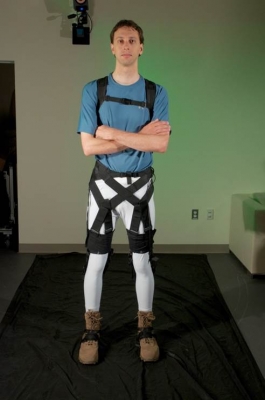
A lightweight wearable robot which subtly assists with human movement? The amazing innovation of wearable technology cannot be achieved without intelligence, countless hours of work, and years of research by those behind the products. Boosted by a recent DARPA grant, Harvard’s Wyss Insititute is developing a Soft Exosuit to assist with walking with the use of textiles and wearable sensors. While not yet a completed product for the market, it is already clear how this wearable robot can potentially change the lives of those with neurological disorders, muscle weakness, the elderly, and those that are fatigue-prone in professions such as the military and first responders.

The components of this product are amazing, especially in their consideration to avoid interference of the device with the user. Elastic textiles that align with certain muscle groups and transmit forces to the body to assist with natural, synergistic movement during gait. Because the textiles are elastic and are unable to measure angles at joints (as rigid components do normally), wearable sensors at the hip, calf and ankle monitor forces and changes in movement. The idea is to provide assistive torque at the joints to mimic normal muscle activity when needed. The sensors track the changes in movement to monitor the types of activities of the user, such as walking or running, to assist with the diversity of everyday activity.

Something especially interesting about the Exosuit is how closely it works with human physiology and biomechanics during gait, including the passive movement of the limbs during walking. Because the functional textiles stretch, they can closely align with muscle groups and assist movement without letting the components interfere with what is natural for the body.

Please see the video below for more:

KaiLin-Klippa-1.jpg

source

Though this isn’t quite robotic, as a rock climber, I have to share this beautifully designed prosthesis by Kai Lin, an industrial design student at the Pratt Institute. This will, once the final prototype is made, hopefully also move toward a myoelectric limb, as many prosthetics will. KLIPPA is a 3D printed prosthetic designed based on the anatomy of a mountain goat,  It is a prosthesis designed for amputee rock climbers, and though the final prototype is not yet formed and is yet to be tested clinically, the design is mostly in place.

If you are an active person who relies on exercise and movement to exist and feel normal, the devastation with an injury leading to amputation is not just the loss of basic functions such as walking and standing. The loss is the inability to participate in the physical activities on which you rely on to feel balanced and relieve stress.  Rock climbing is athletic and mental; physically challenging while requiring upper and lower body strength, and mentally strategic in planning the route in order to ascend.

Rock climbing requires heavily on grip and pressure of the toes; most prosthetics have a bulky and functional forefoot that does not meet these requirements. In order to move upward between footholds, you must push forcefully through the front of the foot.  The KLIPPA takes this into consideration and features an ankle joint with an internal spring for shock, a small contact surface so that climbers can fit onto holds and in wedges, and a hoof-like sole to provide stability. Replaceable rubber shoes and shin guards place into consideration different climbing conditions, as well as the wear and tear of the contact surfaces.

I find it especially moving that this design was created after Mr. Lin found that rock climbing is the top choice of sport for veteran amputees. Please visit his page to see his sketches and other details of this thoughtful project.

KaiLin-Klippa-2.jpg

source

Sound is captured and processed on a smartphone. The data is then sent over BlueTooth and played in real-time using a series of vibration motors on on a wearable vest.

source

Plasticity is truly one of the amazing aspects of the body’s response to injury or malfunction. Just as when traffic is rerouted during an accident or roadblock, it is the brain’s ability to reorganize neural pathways in response to a situation for us to continue to function and survive.  In instances such as hearing loss, these rerouted pathways can be the form of amplified response to vibration to substitute for lacking function of the ear. If the brain is our control center and our senses are just ways to pick up information to send back to the control center, then once we are able to find another way to pick up the information, then the goal (hearing in this instance) is ultimately still achieved.

And what if there was something that amplified the process even more to assist those that go through life with deafness; missing one of the five vital senses? The Eagleman Laboratory has set out to address this. They have begun a Kickstarter campaign for VEST, a wearable extra-sensory device which converts sounds from the environment to vibration.

The skin is the largest organ in the body and provides a huge surface area of sensory input. Using this notion, the VEST works by processing sound in the environment on a smartphone which it converts to vibration. Next, the VEST then picks up these vibratory signals which the skin underneath it hopefully picks up as well. Finally, these signals that the skin has picked up are sent to the brain to process this information. It is ultimately an alternate route to process sound without the use of ears.

In addition to being innovative and easy to operate, VEST provides a low cost, noninvasive alternative to cochlear implants. The founders estimate that the device will cost consumers less than $2,000, while a cochlear implant can cost upwards of $40,000.

source

One of the problems with technology is that especially when it first becomes available, many of those that would benefit from it cannot afford it. So while there are many new great options becoming available for amputees, those that don’t have access to funds are unable to benefit. This is why when a $50 dollar option for a printed mechanical hand is offered to the medical world, it should be embraced and supported.

The E-Nable project is truly amazing. It is a network of over 1500 volunteers dedicated to helping provide affordable 3D printed prosthetics for those that can otherwise not afford the multi-thousand dollar ticket that many prosthetics cost. From 3D printing companies to robotics companies to doctors, this project has a worldwide growing network of people willing to design and contribute to low cost prosthetics for amputees. Crowdfunding and generous donations have also contributed to the cause.

In addition to listing participants that can contribute resources or services, the site offers a number of open source designs available so that those with access to a 3D printer can print and assemble their own hand and finger prostheses.  Currently Included are more basic options, as well as those with myoelectric capabilities. Each option provides open source software and video tutorials on how to assemble. The various options accommodate different types of amputations, for those at the wrist or fingers. There is even an prosthetic for a partial finger amputation, the Owen Replacement Finger.

I cannot fully describe everything involved in this project, please visit the site.  The project will hold its first conference titled “Prosthetists meet Printers” on September 28th, 2014 at Johns Hopkins Hospital to involve more of the medical community and introduce them to the options that are available to their underprivileged patients. This will include physician Dr. Albert Chi, a renowned trauma surgeon at the hospital who has been involved in the project.

To donate supplies or funds, click here.

Below is a sample of one of the instructional videos available, in this case it is the Cyborg Beast :


https://i0.wp.com/www.touchbionics.com/sites/default/files/image-gallery/246_touch_bio_260313.jpg

source

Upper body prostheses have definitely come a long way. For those with amputations at the hand or wrist, gone is the time when the only option was a hook or some other horrific replacement. 

Touch Bionics is a company which makes myoelectric prostheses to replace upper body amputations at the hand and wrist. Myoelectric prostheses are a life-altering product which attach at the remaining part of the limb and are triggered my muscle signals from intact muscle. Touch Bionics has a number of products, and has recently updated their i-limb ultra bionic hand to the i-limb ultra revolution, which includes a rotating thumb and four other articulating digits for up to 36 types of grasp. A mobile app allows the control of these grip patterns, which includes 12 possible customized grips. In addition, a silicone skin-like covering is available in a number of colors to allow for improved grasp and a more skin-like feel.

As we know, hands are very complex body parts with multiple joints that are responsible for numerous different movements, functions, and types of grip. To recreate these movements and try to mimic the function of human fingers, particularly the thumb, is quite difficult. While the loss of a hand naturally causes a great disability, a great product such as this allows an individual to perform a multitude of daily task such as tie their shoes, grasp a pen, or use a smartphone.

Watch the video below for more information:

photosource

There is no doubt that robotics is changing and improving the field of healthcare. While there are many brilliant products being introduced in this field, it is the robotic exoskeleton that I personally find the most amazing. To think that one day we can completely eradicate the long term use of wheelchairs for people with neurological injuries and replace them with a wearable robot which allows them to stand and walk is absolutely inspiring.

The Indego is one of these devices. Weighing in at 26 pounds, this modular device comes in 5 pieces and is put on in components over the legs, hips and torso. The light frame of the device allows users to keep it on even while in a wheelchair prior to use. The device responds to weight shifts in order to guide movement. A forward lean allows the device to help users stand and walk, while leaning backward stops movement. Modular components at the hip and legs propel forward movement at the joints once initiated.

Currently only available for research purposes in rehabilitation centers, the website states it anticipates commercial sales in the US in 2016.

See the video below for demonstration and more information:

source

Printing is currently extremely inconvenient if you do not have regular access to a printer. Which is why it is so exciting that a mobile printer is in production and will be available for sale as early as next year. The Zuta Labs Mini Mobile Robotic Printer is a 10 x 11.5 centimeter pocket printer which is essentially an inkjet that rolls over whichever paper on which you need to print. The printer just needs a wireless connection, and can be recognized on computers as a regular printer. It supports iOS, Android, Linux, and Windows. The mobile printer is designed to start at the top of the page, and an inkjet rests on multidirectional wheels in order to cover the surface on which it is printing.

The Pocket Printer’s Kickstarter page has met its goal, but is still accepting backers in order to add more features.

See the videos below for a demonstration of how the device will look when it is working and their informational Kickstarter video:


For those with diminished strength or function of the hand, daily tasks that we often take for granted may become difficult, essentially disabling someone in their daily life. To address this and increase efficiency of the performance of the hand, researchers at MIT have developed “Supernumerary Robotic Fingers,” a type of wearable robotic device with two extra fingers to complement the grasping function of a regular hand.

In normal human movements we have muscles that work synergistically, meaning that there is a central signal from the brain that allows them to contract together to create a certain movement. For example, when the biceps contracts to bend the elbow, the muscle brachialis contracts as well to help facilitate this movement. This allows for efficiency of tasks in our body.

An article titled Bio-Artificial Synergies for Grasp Postural Control of Supernumerary Robotic Fingers explains how the researchers have developed an algorithm to allow the robotic fingers to work synergistically with human hands. That is, the extra fingers are designed to correlate with the human movements to work as an extension of the human hand and enhance activity to form essentially a seven-fingered hand. The researchers use the concept of “Bio-Artificial Synergy.” Thus, the researchers have essentially developed extra fingers that replicate the movements of muscles in the human hand.

The device is mounted on the wrist, and through a sensor glove receives a signal from the hand and works alongside the five fingers to assist with grasping objects. The robotic fingers are longer than human digits, making it easier to grasp larger objects. Each robotic finger can move in 3 different directions. For those that have difficulty holding onto objects or performing coordinated movements, this can be an invaluable tool to perform tasks independently.

Because of these extra fingers, the user is able to perform tasks that are normally difficult to perform single-handedly, such as twisting open a bottle cap, holding a tablet and typing, This product is still in the development phase, and though researchers have amazingly been able to correlate the robotic hand angles with human hand angles for grasp, they have not yet completed algorithms for fingertip forces.

The article mentions that this devices has implications not only for elder care, but for construction and manufacturing.

See the video below for more description of this amazing device:

photo source